Amino-acid chains
Examples in this catalog include MOTS-c, GHK-Cu, Semax, Selank, and tesamorelin. Each has its own evidence, status, and intended context.
This catalog contains materials and product profiles intended for legitimate laboratory, analytical, or research purposes only. Research-use products are not for human or veterinary use, consumption, self-administration, treatment, diagnosis, or clinical application.
Peptides and related research compounds are not interchangeable. This guide explains classification, signaling concepts, evidence levels, and how to evaluate laboratory product information without turning research findings into consumer treatment claims.

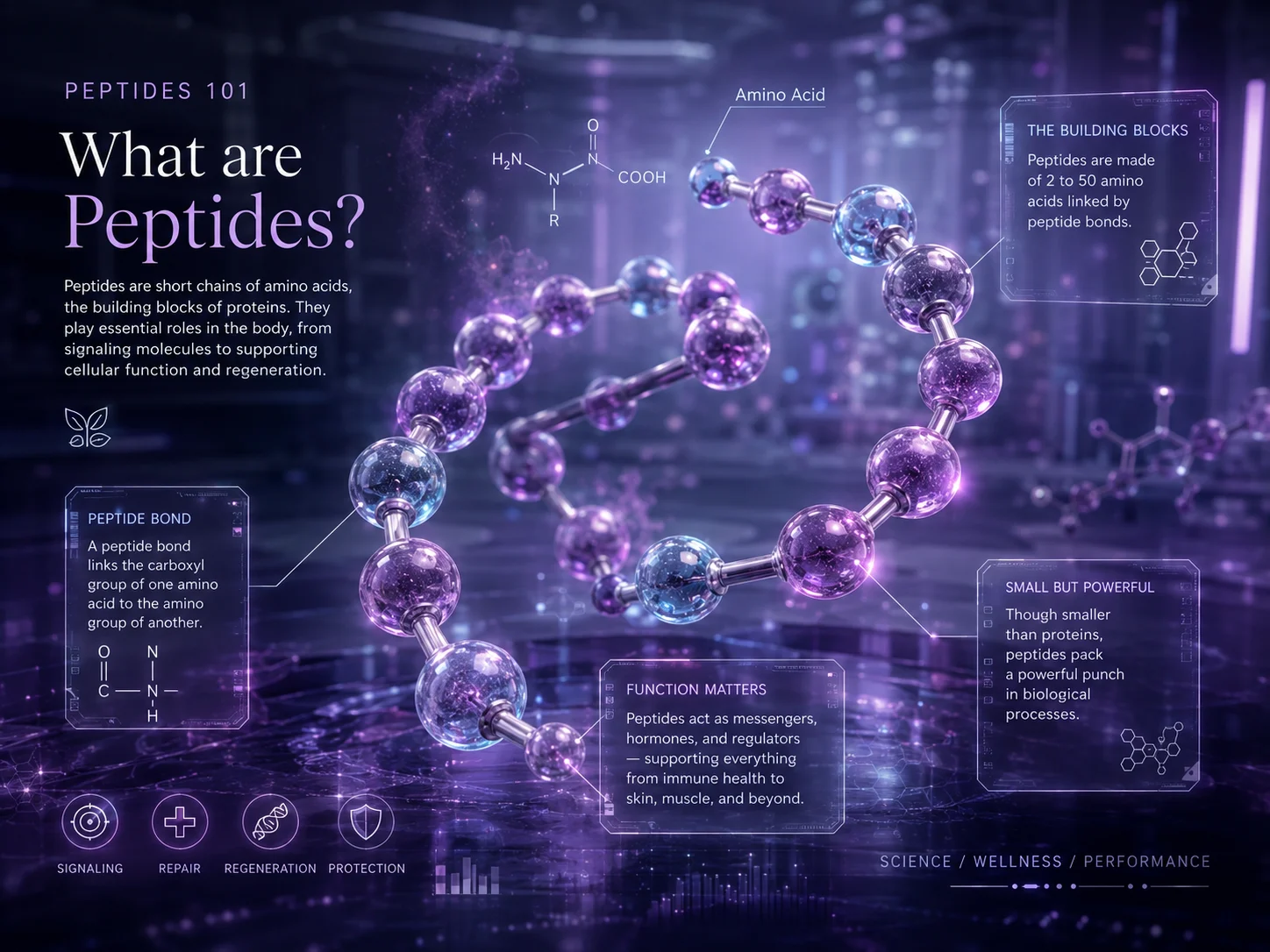 Educational concept graphic • use page text for precise context
Peptides are molecules made from amino acids linked by peptide bonds. They are generally shorter than proteins, and their biological behavior depends on the exact amino-acid sequence and structure.
Some peptides occur naturally in the human body and participate in signaling or regulation. Others are manufactured for approved medicines, diagnostics, cosmetics, or laboratory research. That range is why the name of the specific compound matters more than the category label alone.
Accurate classification keeps the science language honest. Several research products are commonly discussed alongside peptides even though they belong to different chemical categories.
Examples in this catalog include MOTS-c, GHK-Cu, Semax, Selank, and tesamorelin. Each has its own evidence, status, and intended context.
NAD+ participates in cellular redox reactions and energy metabolism. It is not a peptide and should not be described as one.
5-Amino-1MQ is a small-molecule research compound associated with NNMT research. It is not a peptide.
Bacteriostatic water is a sterile diluent category, not an active wellness ingredient and not a peptide.
Many peptides act by interacting with receptors or other biological targets. The downstream response depends on the molecule, receptor, tissue, dose, route, and physiological context.
 Educational concept graphic • not a treatment claim
A specific peptide reaches a biological target such as a receptor.
The target recognizes particular structural features of the molecule.
Receptor activation or another interaction can start a downstream cellular pathway.
The observed effect depends on the compound and the quality of the evidence supporting that use.
Both peptides and proteins are built from amino acids. Proteins are typically larger and often fold into complex three-dimensional structures. Peptides are shorter, but “shorter” does not mean weaker, safer, or interchangeable.
Two products can both be called peptides while acting through very different pathways. Claims should therefore be compound-specific, formulation-specific, and supported by the relevant evidence.
Categories such as metabolic, beauty, cognitive, recovery, and cellular are navigation tools—not guarantees of outcomes. They help organize the catalog while each product page explains its own status.
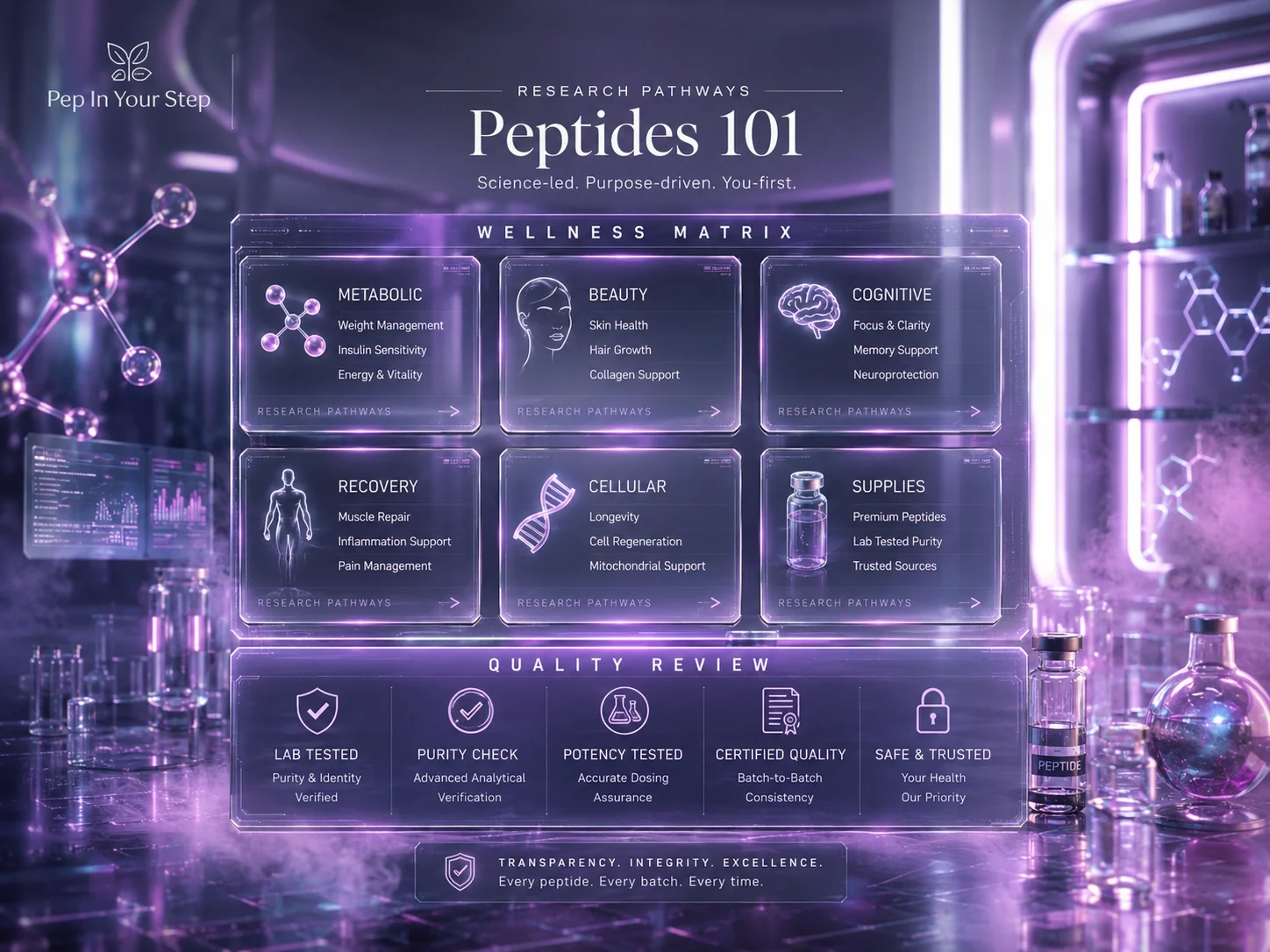 Navigation concept • product-specific status appears on each profile
Evidence quality is not binary. A compound may have an approved medical use, human clinical studies for another question, early-stage research, or mainly preclinical data.
An approved drug has a defined label for specific indications, dosing, formulation, and safety information. Approval of one branded drug does not make every product containing the same named ingredient an approved drug.
Human studies can provide useful information, but study design, population, formulation, dose, duration, and endpoints determine what conclusions are reasonable.
Some compounds are being studied but do not have an established approved use. Marketing should not turn an investigational finding into a guaranteed consumer benefit.
Preclinical results can guide research questions, but they do not automatically predict effectiveness or safety in people.
Quality and interpretation depend on the actual material being offered, not just the headline name.
Salt form, excipients, blend composition, and concentration can change how a product should be evaluated.
Topical, oral, nasal, injectable, and other routes are not interchangeable and can have different evidence and safety considerations.
Identity, purity, concentration, sterility where applicable, storage, and traceability are separate quality questions.
Legal availability, prescription requirements, and investigational status can differ by compound and jurisdiction.
A Certificate of Analysis can provide batch-specific analytical information, but it does not by itself establish approval, clinical effectiveness, safe use, or sterility unless those items are specifically and appropriately tested.
This page is designed to explain terminology used in research literature and product documentation. It does not authorize human or veterinary use, diagnose a condition, recommend treatment, prescribe a product, provide dosing or administration instructions, or establish that a research material is safe or effective for clinical use.